
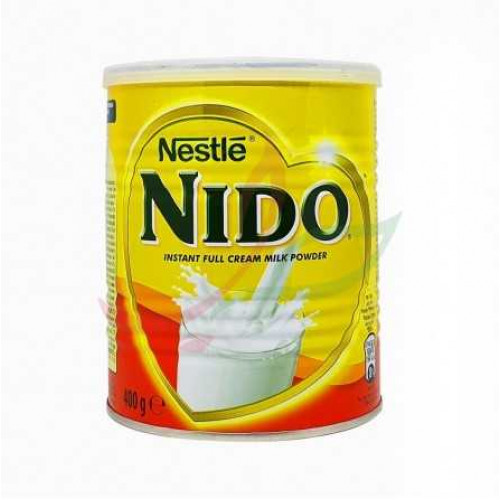
Lait en poudre Nestle Nido 400g.
€350.00
Packaging: 100 Jars
Price: €3.50
Price per pallet (including VAT): €350
Average shelf life: 360 days
Origin: Switzerland
Ingredients: whole milk powder, emulsifier: soy lecithin.
Who invented powdered milk for babies?
Before the advent of buying powdered milk in bulk, maternity wards often relied on the good care of donkey milk, and more rarely goat or sheep milk, to feed orphans or children whose mothers could not buy powdered milk in bulk and who did not have a wet nurse.
In 1908, Maurice Guigoz invented the first powdered milk by heating cow’s milk under vacuum at a low temperature. Within a few decades, the techniques improved and the use of powdered infant formula became widespread.
It goes without saying that the use of infant formula revolutionized the world of early childhood by significantly reducing infant mortality and freeing millions of women from breastfeeding at a time when they were entering the workforce en masse.
Today, France has one of the lowest breastfeeding rates at birth, with approximately 60% of mothers breastfeeding, compared to nearly 100% in Norway and 85% in Italy. By 12 weeks, this rate drops to around 30%, with many mothers opting for bulk purchases of formula. Even though breastfeeding is increasing, formula remains a crucial part of infant nutrition and a major public health issue.
ON THE SAME SUBJECT
Breast milk versus formula: which breast to choose?
Looking to buy powdered milk in bulk at the best prices?
Powdered milk in bulk.
Four questions to understand the crisis in buying powdered milk in bulk at the best prices.
What’s inside?
Infant formula is, first and foremost, cow’s milk (in the vast majority of cases). This milk is designed to transform a 45 kg calf into a 700 kg ox! It’s milk suited to a herbivore with a digestive system very different from a human’s. That’s why, in its raw form, it’s not really suitable for a human baby. In particular, it contains three times too much protein, too much saturated fat, and not enough lactose and other sugars. It lacks vitamins and iron but contains too much sodium and calcium.
That’s why powdered milk is completely transformed to meet the needs of infants. It’s skimmed, pasteurized, and enriched with lactose, glucose, vitamins, and amino acids. Vegetable fats and emulsifiers are also added. Everything is mixed together, dried, and the result is the famous stage 1 and stage 2 infant formulas! Some formulas may be enriched with probiotics, fiber (prebiotics), or nucleotides that help the baby’s digestive system develop.
The recent scandal of Lactalis milk contaminated with salmonella is yet another episode that shows how sensitive infant nutrition is.
After this complex process of buying powdered milk in bulk at the best prices, the resulting powdered milk has a composition very close to that of breast milk. The main differences are the absence of antibodies and (most often) other substances like choline (which plays a role in the infant’s brain development). Finally, breast milk is constantly evolving and naturally adapts to the baby’s changing needs with much greater precision than infant formula.
Who controls it?
The purchase of powdered milk in bulk is subject to specific European regulations designed to protect babies. Market access is strictly controlled and promotional claims are regulated, but this doesn’t prevent marketing from operating at full capacity with very wide product ranges. From a health perspective, the plant protection products used in its manufacture are limited and controlled. Pesticide residues are not prohibited but are limited to 0.01 mg per kg of each active substance.
In 2008, the contaminated milk scandal in China affected 300,000 babies and caused a 30 to 40% drop in sales for the Chinese sector. This affair went down in history as one of the worst global food scandals, even leading to death sentences.
On the other hand, there is nothing preventing the use of non-organic cow’s milk and there is no specific legislation limiting the purchase of powdered milk in bulk, which is present in half of infant formulas according to a 2014 study. And as the Lactalis case shows, production processes can still be improved to guarantee maximum food safety for our babies who need other sugar products.
How to find your way among the different types of milk?
New parents are vulnerable and often ready to swallow any argument as long as they’re promised the best for their children. Brands play on their anxieties and respond with a frankly bewilderingly wide range of products. Buying powdered milk in bulk is a challenge for the uninitiated, as the powdered milk aisle in supermarkets is becoming as sprawling as the wine aisle offering the best prices! So, without going so far as to become a baby sommelier, here are a few pointers to help you make informed choices:
Organic or not organic?
Organic infant formula undergoes the same industrial processing as non-organic formula. The only difference is that, in the former case, the cow’s milk comes from an organic farm. And since health regulations for infant formula are stricter than for conventional dairy farming, the impact on health is not very significant.
On the other hand, environmental impact can be the criterion of preference if one opts for organic milk.
The terrifying palm oil!
The reasoning here is quite similar to the previous point: palm oil may be questionable for adult health but is much better suited to the needs of infants. Furthermore, bulk-purchased powdered milk naturally contains 23% palmitic acid.
Environmental concerns will be the primary factor guiding your choice.
Pharmacy or supermarket?
Silly question? Perhaps, but some people still have the impression that milk bought in a pharmacy is of better quality than its equivalent in a supermarket… Well, no! If the label is the same, the contents are also the same in a coffee machine and other products.
Vegan or not?
If you are vegan, the best solution is usually found at the tip of the nipples! In cases where breastfeeding is impossible or for babies intolerant to animal proteins, there are now rice protein milks that work but are recommended by pediatricians as a last resort rather than a simple alternative.
Is buying powdered milk in bulk worthwhile?
The French powdered milk and other sugar products sector has found a way to continue developing the industry beyond the age of one. This is how stage 3 milk came about, marketed as suitable for children aged one to three and often sold in bottles. This growing-up milk is primarily enriched with iron and vitamins, which does indeed meet the needs of young children. These needs can also be met by a good quality solid food diet. So, it’s not essential. France is, in fact, one of the few countries in the world that buys powdered milk in bulk and consumes it on a massive scale.
Related products


CRISTALINE Eau minérale plate 1,5L
Original price was: €300.00.€230.00Current price is: €230.00.

Lingot d’or Toblerone 100g
Original price was: €3,099.00.€2,736.00Current price is: €2,736.00.

Mon Chéri 157g
Original price was: €2,099.00.€1,872.00Current price is: €1,872.00.



Reviews
There are no reviews yet.